Can the Sheffield Lake Mayor Act in Place of the Law Director and Threaten Legal Action?
Are Cease, Stop, and Desist letters coming from the Mayor of a Community Threatening Legal Action, Legal?
PREPOSTEROUS AND ABSURD
Jon Morrow
12/6/20252 min read
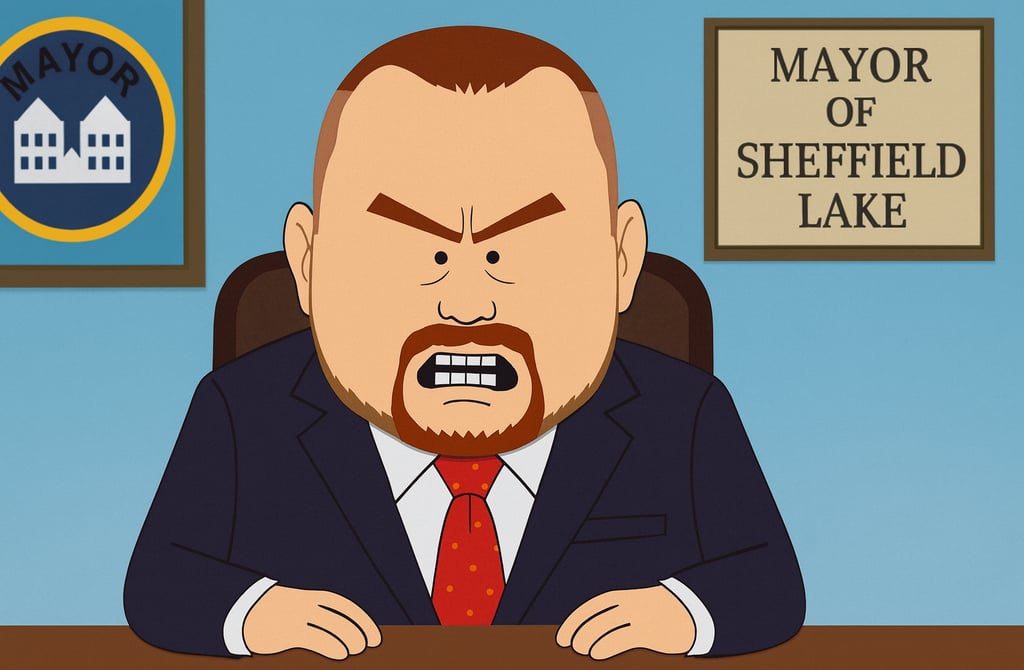
In Sheffield Lake, the city’s law director—rather than the mayor—has the exclusive authority to represent the municipality in legal matters. The mayor cannot act as counsel, initiate litigation, or issue formal legal threats on behalf of the city unless specifically authorized by the law director and approved or ratified by the city council. Doing otherwise raises a separation of powers issue under both the Sheffield Lake Charter and the Ohio Revised Code.
Legal Analysis
Issue: Whether the mayor of a chartered municipality such as Sheffield Lake can independently perform or direct legal actions on behalf of the city, or whether council authorization and law director deputization are required.
Rule:
Under Ohio Rev. Code § 733.51, the city director of law prepares all legal instruments and serves as the legal counsel for municipal officers, including the mayor.[1] Similarly, Ohio Rev. Code § 733.54 provides that when an officer, such as a mayor, has a legal question concerning official duties, they must formally seek and follow the written opinion of the city’s law director.[2]
The Sheffield Lake Charter mirrors this statutory division of powers. Article III, Section 5 specifies that the mayor is the city’s chief executive officer, charged with administering municipal affairs and overseeing departments—not performing legal representation.[3] In contrast, the Department of Law under Section 2 of the charter designates the director of law as the exclusive counsel for the mayor, council, and departments, and as the city’s representative “in all court proceedings or before administrative boards.”[4]
As a result, Ohio’s municipal governance scheme maintains a local separation of powers similar to state-level divisions between the executive and legal functions. The mayor executes laws and oversees operations, while the law director, typically independent and council-approved, is the city’s sole legal authority.
Application:
If the mayor—acting in their administrative capacity—threatens litigation against a resident without express council approval and the law director’s formal participation, that constitutes an unauthorized act. Even if the law director later approves, the mayor’s unilateral communication of a legal position or threat exceeds the executive role established by the charter. This overlap into the law director’s domain implicates separation of powers concerns because it merges the mayor’s executive duties with the law director’s independent judicial and legal functions.
Furthermore, under R.C. 2921.45(A), a public official who, under color of office, deprives an individual of constitutional or statutory rights may be subject to criminal liability. If a legal threat is issued as a means of deterrence outside lawful municipal process, this exposure increases.
Conclusion:
Yes. In Sheffield Lake, the mayor cannot lawfully act as legal counsel for the city or threaten litigation without (1) express authorization from council, and (2) delegation or formal action by the law director. Any attempt by the mayor to assume such powers—regardless of their legal background—would contravene local charter provisions, the Ohio Revised Code, and the principle of separation of powers that protects against the fusion of executive and legal authority.
References
1.
Section 733.51 Powers and duties of city director of law
Ohio Revised Code · Title 7 – Municipal Corporations · 1977
2.
Section 733.54 City director of law shall give opinions
Ohio Revised Code · Title 7 – Municipal Corporations · 1977
3.
Sheffield Lake Charter Article III §5 Duties and Powers of Mayor
City of Sheffield Lake Charter · Article III – The Mayor · 1961; amended 1967
4.
Sheffield Lake Charter Article VII §2 Department of Law
City of Sheffield Lake Charter · Department of Law · Amended 2015
The Sheffield Lake Forum
Paid for by the committee - For a Better Tomorrow - Elect Jon Morrow
Text or call
"We all win when we make our voices heard!"
(419) 602-4425
© 2025. All rights reserved.

Disclaimer
The website www.SheffieldLake.community is both a work of irony and a platform of ideas.
It playfully satirizes the hypersensitivities of those who zealously defend Mayor Rocky Radeff’s policies, while earnestly offering real-world proposals for improving life in Sheffield Lake.
This site serves two purposes:
To highlight, through gentle parody, the contradictions and overreactions that too often dominate local discourse, and
To present serious, forward-looking solutions for residents to evaluate and discuss.
While its tone occasionally employs humor and irony, the underlying intent is civic — to inform, challenge, and inspire thoughtful conversation about the future of our city.
Authorized and maintained by Jon Morrow, Councilman-Elect, Ward 1, City of Sheffield Lake.