
CHARTER AMENDMENT - The Case for a Full Time Mayor
When the Mayor needs a multitude of paid assistants to get the job done, it would be cheaper just to pay the Mayor to be a full-time Mayor!
PROPOSED RESOLUTIONS AND POLICIES
12/6/20254 min read
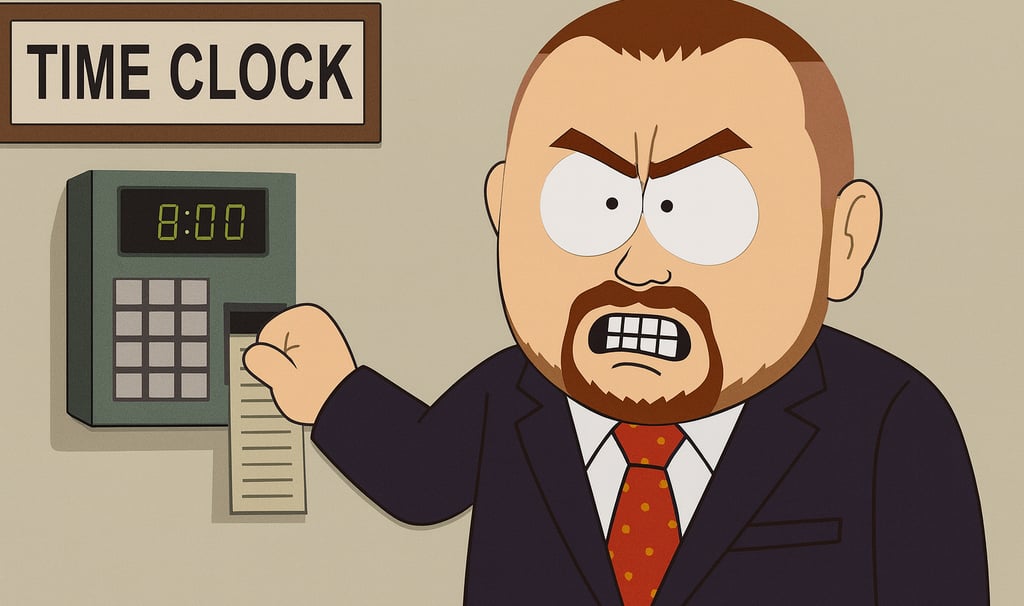
Sheffield Lake likes to call itself a small town. It wears that phrase like a comfortable coat. But comfort is not a form of government. We are not a village. We are a city—modest in acreage, yes, but not in responsibility. Our streets, budgets, contracts, public safety systems, utilities, and development prospects do not shrink because we prefer nostalgia. And yet we keep running our executive branch as if we were a sleepy hamlet whose greatest municipal challenge is which picnic table needs repainting.
The City Charter, tellingly, does not declare the Mayor’s position part-time or full-time. That silence is not a license for drift; it is a warning label. It means the guardrails have to be set by City Council—by the body that represents the whole city and controls the purse. If Council refuses to define expectations, then the office defines itself by inertia, personality, and political convenience. That is not “local flavor.” That is a design defect.
Let’s say the quiet part out loud: we get what we pay for. In Sheffield Lake, a City Council seat pays around $7,000 a year. That is not a salary; it is a token. So we shouldn’t be shocked when we don’t get a deep bench of high-caliber candidates willing to endure the grind of legislation, constituent fires, and public contempt for less than the cost of a modest used car. This is not an insult to those who serve. It’s just economic law applied to politics. Incentives do what incentives do.
The same law governs the Mayor’s office. You cannot run a city on a bargain-basement executive and then act surprised when you receive bargain-basement oversight. You cannot hire a stack of assistants to compensate for a thinly present Mayor and tell the taxpayers it’s “efficient.” It isn’t. It’s a shell game. We didn’t elect assistants. We elected a Mayor.The assistants are not accountable at the ballot box. They don’t carry the mandate. They don’t answer for the city’s direction in the way the Mayor must. If the Mayor’s role is diluted into a managerial relay race, then the office becomes a title, not a function.
So here’s the question every honest citizen should ask: how few hours is too few?
Is four hours a week enough to lead a city?
Ten?
Twenty?
Thirty?
At what point do we stop calling it “part-time civic service” and start calling it what it is: public administration by absentee landlord. Traditional practice is not an argument; it is a habit. And habits are fine for brushing your teeth. They are fatal for governing a city facing real-world pressures—state mandates, county coordination, shrinking trust, and the constant need to pursue development before someone else does.
A full-time Mayor is not a luxury. It is a recognition of reality. A full-time Mayor has time to interface with county commissioners and regional partners, to show up where decisions are actually made. A full-time Mayor can meet with our state representative, go to Columbus when the city must be heard, and if necessary walk into D.C. and fight for Sheffield Lake’s interests instead of sending an email that disappears into a staffer’s inbox. Economic development is not a thing that happens by accident between lunch breaks. It is hunted. It is negotiated. It is closed—by a person who has the time to do it.
A full-time Mayor also calls corruption what it is: a fungus that grows in darkness and neglect. Oversight takes time. Transparency takes time. Budget review, contract scrutiny, departmental performance audits, and the daily presence that tells everyone in city hall, “someone is watching,” all take time. A Mayor who is present can curb bad habits before they harden into scandals. A Mayor who is absent leaves the city to be run by whoever happens to be most persistent in the hallway.
And let’s talk about the public. What happens when a part-time Mayor isn’t available during business hours?
Isn’t the public cheated?
When the Mayor is tied up at a primary job, unable to take calls, unable to meet residents, unable to respond quickly to crises that don’t wait politely until after 5 p.m., what exactly are citizens paying for? We are not paying for a ceremonial ribbon-cutter. We are paying for the chief executive of our city.
Here’s what the present model buys us:
a Mayor with constrained hours,
a growing dependency on unelected assistants,
slower decisions,
weaker oversight,
diminished accountability,
and higher cost disguised as “support.”
That is the worst possible combination: more expensive, less efficient, and less accountable. It is the bureaucratic version of buying a cheap engine and then paying double for repairmen to keep it running.
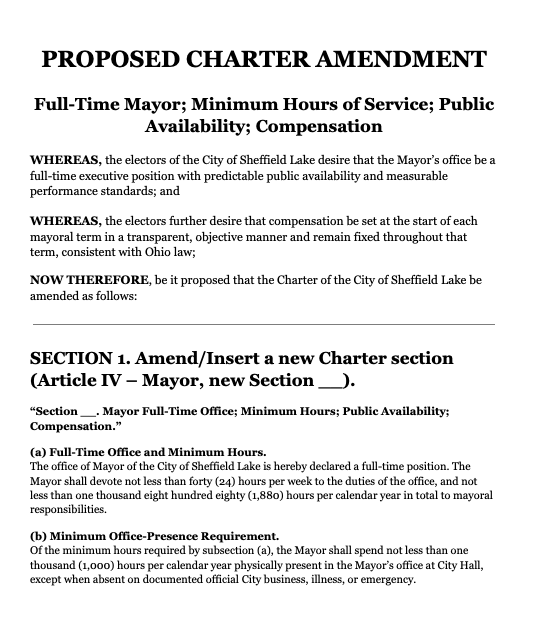
Council’s job is to set the guardrails precisely because the Charter doesn’t. In a well-ordered city, nobody should wonder whether the Mayor is working four hours or forty. The people should not have to guess how much city leadership they are getting. That expectation should be written, measured, and enforced. Not out of hostility to any one person, but out of loyalty to the institution and to the citizens who fund it.
The point is not to punish a mayor. The point is to respect the office enough to demand that it be real. A full-time Mayor is a city saying, “We intend to govern ourselves seriously.” Sheffield Lake can keep drifting on tradition, substituting assistants for accountability, and calling that “small-town charm.” Or we can decide that the future deserves more than charm—that it deserves competence, presence, and a Mayor who actually has the hours to do the job we elected him to do.
If we want Sheffield Lake moving forward, then it’s time to make the change.
The Sheffield Lake Forum
Paid for by the committee - For a Better Tomorrow - Elect Jon Morrow
Text or call
"We all win when we make our voices heard!"
(419) 602-4425
© 2025. All rights reserved.

Disclaimer
The website www.SheffieldLake.community is both a work of irony and a platform of ideas.
It playfully satirizes the hypersensitivities of those who zealously defend Mayor Rocky Radeff’s policies, while earnestly offering real-world proposals for improving life in Sheffield Lake.
This site serves two purposes:
To highlight, through gentle parody, the contradictions and overreactions that too often dominate local discourse, and
To present serious, forward-looking solutions for residents to evaluate and discuss.
While its tone occasionally employs humor and irony, the underlying intent is civic — to inform, challenge, and inspire thoughtful conversation about the future of our city.
Authorized and maintained by Jon Morrow, Councilman-Elect, Ward 1, City of Sheffield Lake.