
Government in the Open: Bringing Sheffield Lake’s Lawmaking Into the Light
No more “emergency” shortcuts. Citizen Advisory Committees bring a Statehouse-style process to Sheffield Lake — committee review first, public pro & con testimony on the record, and testimony posted online for all to see. Slower lawmaking, better decisions, less corruption, more trust.
PROPOSED RESOLUTIONS AND POLICIES
12/8/20254 min read


A city is not a room full of chairs and microphones. It is a machine of decisions. And like every machine, it can be either a tool for human flourishing or a weapon for human submission, depending on how it is designed.
Sheffield Lake has lived too long with a design that invites the worst temptation of politics: treating the public as an afterthought.
Citizen Advisory Committees are the corrective, not as decoration, not as “community engagement theater.” Still, as a structural assertion of a single moral principle, the people are not spectators to their government. They are its source.
The necessity: power without structure becomes whim.
When legislation is rushed, when emergencies multiply, when decisions arrive already sealed in private, something predictable happens. The rational citizen withdraws—the cynical citizen sneers. The well-connected citizen thrives. And the city slides into the rule of rumor, the rule of insider knowledge, the rule of what can be arranged rather than what can be justified.
That is not politics in the noble sense. That is tribal management under a democratic guise.
Citizen Advisory Committees interrupt that slide by inserting a required chamber of daylight between proposal and power. The point is not to make government sentimental. The point is to make it rational.
The advantage of committees is not delay. It is reality-testing.
To those who fear that committees “slow things down,” the answer is simple: good law should not fear time.
Time is what separates the considered from the impulsive. It is what allows evidence to accumulate, alternatives to surface, and consequences to be named aloud. A measure that cannot survive proponent testimony, opponent testimony, and interested-party testimony does not deserve to become law. It deserves to be corrected or destroyed before it harms anyone.
The proposed committees require exactly that:
The sponsor must read and defend the proposal,
Proponents must make their case publicly,
Opponents must be heard distinctly and fully,
Interested parties must add the perspective of those who live with the outcome.
This is the legislative equivalent of an engineering review. Concrete is not poured before you review the blueprint. You should never pass ordinances before you test the arguments.
This mirrors the Ohio General Assembly for a reason: it is how serious law gets made.
What we are building locally is not an experiment. It is the logic of mature self-government, the same reasoning used by the Ohio General Assembly.
At the Statehouse, a bill does not leap from a sponsor’s desk into law. It goes first to a committee. Always. The House sends bills to House committees; the Senate sends bills to Senate committees. That is where the bill is earned.
It is in committee that the real case is made:
Proponents testify and put their arguments in the record.
Opponents testify and test the bill against reality.
Interested parties speak to consequences lawmakers may not see from behind their desks.
Only after this gauntlet of reason does a bill move forward to the floor of the House or Senate for readings and a vote. The committee stage is not a detour. It is the checkpoint between power and proof.
We are simply importing that same checkpoint into Sheffield Lake: a city-scale version of the process that governs the entire state. The purpose is identical—to prevent law from being made in a vacuum, or worse, in a hurry.
The advantage of posted testimony is the end of “government by grapevine.”
The grapevine is what grows in the dark. It thrives on speed, ambiguity, and the absence of record. It turns citizens into scavengers for hints and leaks.
By requiring testimony to be posted—written, audio, video, and in-person—this system performs an act of civic hygiene:
It preserves the reasons for and against,
It prevents history from being rewritten after the vote,
It allows every resident to judge with the same evidence,
It makes power accountable to facts, not to narratives.
Nothing drains corruption faster than a record.
When the argument is public and permanent, the manipulator loses his favorite tool: deniability.
The advantage of the appointment structure is anti-capture.
Committees can be noble or useless, depending on whether they are designed to deliberate or to obey. We designed them to deliberate.
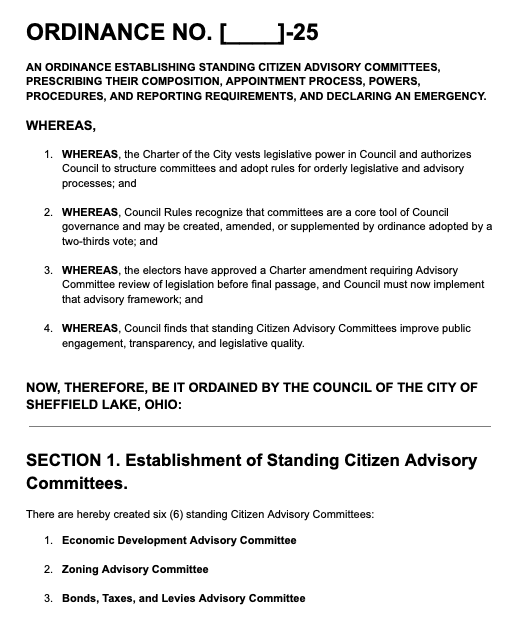
Four Ward-designated appointments first, in transparent order.
Then the Council President.
Then the Mayor.
Party-balance limits so no committee becomes a faction in disguise.
No more than two appointees from the same party.
The members choose the chair, and the chair votes only to break ties.
The chair sets the agenda, but a concurrence of four can amend it.
This is not a nod to “bipartisanship.” It is a practical rejection of monopoly. It is the legal embodiment of the truth that no group, left unchecked, remains objective when power is at stake.
We are building committees that cannot be quietly stacked, ruled by a single personality, or turned into a rubber stamp without open collaboration.
The advantage of allowing expertise (even outside city limits) is competence.
A city is not an island of knowledge. If you confine advisory services only to those who live within a boundary line, you are not elevating local pride—you are strangling local wisdom.
By allowing qualified non-residents—U.S. citizens with relevant experience—to serve, we make a rare statement in municipal life: competence matters, not as an abstract slogan but as an operational requirement.
And because bylaws must be filed with the Clerk and approved by Council, we keep expertise subordinate to transparency and local control.
What these committees really change
They reverse the government’s posture.
Instead of:
“We will decide, then you may speak.”
They say:
“You will speak, then we will decide.”
That is not populism. It is not mob rule. It is procedural justice—the kind that makes obedience moral because it makes law intelligible.
They do not legislate in place of the Council. They do something more foundational: they force legislation to earn the right to exist in public view before it becomes binding on private lives—exactly as legislative committees do at the state level.
The kind of city this creates
A city where:
Laws are weighed before they are wielded,
Dissent is not tolerated as noise but required as a test,
Competence is sought, not feared,
and the public record belongs to everyone—not to those who control the meeting clock.
Citizen Advisory Committees are the architecture of self-government. They say to every official, regardless of party or personality: You may propose anything. You may not impose it without reason.
And they say to every resident: Your city is not something done to you. It is something you build—by thought, by speech, by evidence, and by the courage to insist that law be made in the open.
That is why they are necessary.
That is why they are an advantage.
That is what makes a city worthy of free people.
The Sheffield Lake Forum
Paid for by the committee - For a Better Tomorrow - Elect Jon Morrow
Text or call
"We all win when we make our voices heard!"
(419) 602-4425
© 2025. All rights reserved.

Disclaimer
The website www.SheffieldLake.community is both a work of irony and a platform of ideas.
It playfully satirizes the hypersensitivities of those who zealously defend Mayor Rocky Radeff’s policies, while earnestly offering real-world proposals for improving life in Sheffield Lake.
This site serves two purposes:
To highlight, through gentle parody, the contradictions and overreactions that too often dominate local discourse, and
To present serious, forward-looking solutions for residents to evaluate and discuss.
While its tone occasionally employs humor and irony, the underlying intent is civic — to inform, challenge, and inspire thoughtful conversation about the future of our city.
Authorized and maintained by Jon Morrow, Councilman-Elect, Ward 1, City of Sheffield Lake.