Putting Sheffield Lake's Finances on Line for the World to See
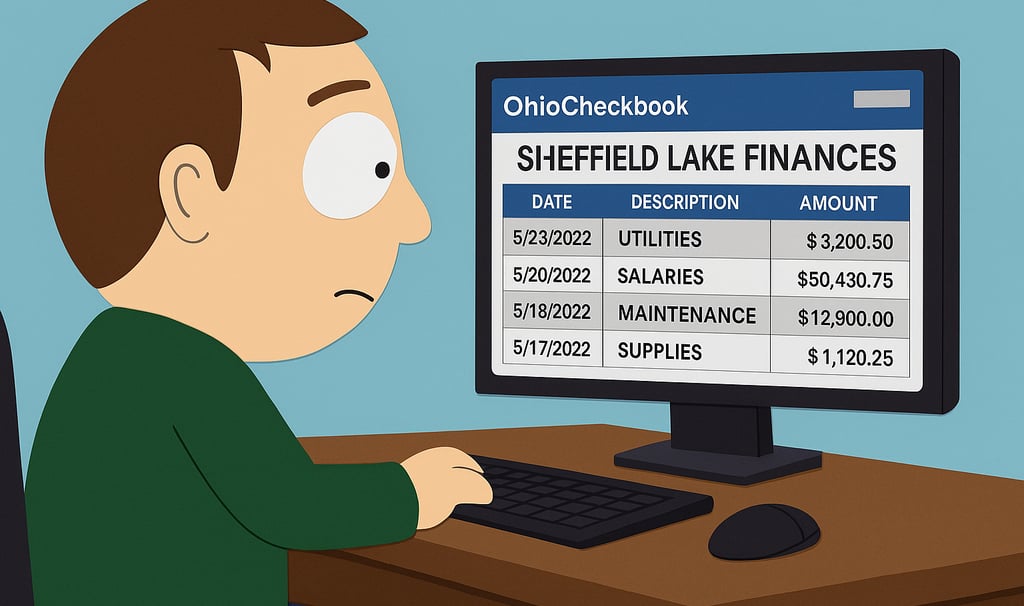
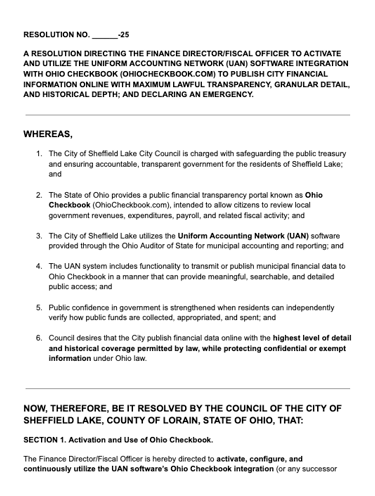
It is free to put Sheffield Lake's Finances online, and it costs us nothing to do so. Why on earth would we not put our finances online? Why haven't we put our finances online sooner?
PROPOSED RESOLUTIONS AND POLICIES
12/6/20252 min read
There is a peculiar superstition in small governments: that the public treasury is safer when it is obscure. That the citizens who fund the city are somehow unqualified to see what is done with their money, that questions are impertinent, that sunlight is a threat. This superstition is not an accident. It is a tool.
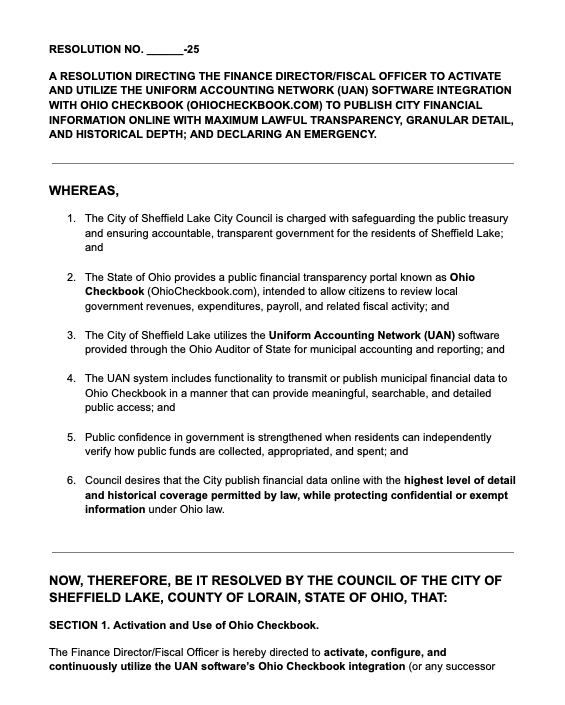
The resolution to publish Sheffield Lake’s finances through Ohio Checkbook is necessary because it restores the only moral chain of custody in a free society: from the citizen, to the government, and never the other way around.
Every dollar in City Hall begins in a private pocket. It is earned by men and women who rise early, take risks, run shops, repair roofs, raise families, and keep the real world turning. Government possesses nothing of its own. It is not a producer. It is a steward—by permission, not by entitlement. When a steward refuses to show the ledger, he is no longer stewarding. He is commandeering.
Secrecy in public finance is not “neutral.” It is not “just the way things are done.” Secrecy is a claim of ownership. It says: This is ours now. You may pay, but you may not know. That claim is incompatible with republican government. It is the psychology of the back room, not the council chamber.
Transparency, then, is not a public-relations gesture. It is the operational definition of accountability. When the financial data is published in maximum lawful detail—vendor, amount, fund, line item, purpose, payroll categories, historical years—the city is forced to live in the world of facts. Not rumors. Not reassurances. Not “trust us.” Facts. The kind that can be checked by any resident with a computer and a spine.
Some will mutter about “complexity,” as if complexity were a reason to hide reality. But complexity is precisely why you publish. A simple system can be watched casually; a complex one demands instrumentation. Ohio Checkbook is that instrumentation—an honest gauge on an engine that belongs to the people.
Others will worry that citizens might “misunderstand” the numbers. That argument is a confession. If a policy cannot survive the public’s inspection, the policy is the problem—not the public. The cure for confusion is explanation, not concealment. You do not improve competence by forbidding sight.
This resolution also matters for the future because memory is power. When only the current year is visible, every budget becomes an orphan, every deficit a surprise, every trend a mystery. By publishing the maximum number of prior years UAN allows, the city gives residents a timeline of reality. It lets them ask the most dangerous question to any mediocre administration: Compared to what?
Sheffield Lake deserves to be governed like a community of adults, not managed like a pantry in someone else’s house. The taxpayers are not intruders in their own city. They are the principals. Council and administration are the agents. Agents keep records. Principals are entitled to see them.
That is why the resolution is necessary. It does not create trust by demanding it. It earns trust by making evidence unavoidable. And in a city that intends to be honest, evidence is not a threat. It is the point.
The Sheffield Lake Forum
Paid for by the committee - For a Better Tomorrow - Elect Jon Morrow
Text or call
"We all win when we make our voices heard!"
(419) 602-4425
© 2025. All rights reserved.

Disclaimer
The website www.SheffieldLake.community is both a work of irony and a platform of ideas.
It playfully satirizes the hypersensitivities of those who zealously defend Mayor Rocky Radeff’s policies, while earnestly offering real-world proposals for improving life in Sheffield Lake.
This site serves two purposes:
To highlight, through gentle parody, the contradictions and overreactions that too often dominate local discourse, and
To present serious, forward-looking solutions for residents to evaluate and discuss.
While its tone occasionally employs humor and irony, the underlying intent is civic — to inform, challenge, and inspire thoughtful conversation about the future of our city.
Authorized and maintained by Jon Morrow, Councilman-Elect, Ward 1, City of Sheffield Lake.