Reducing Emergency Actions by Council and Increasing Public Participation
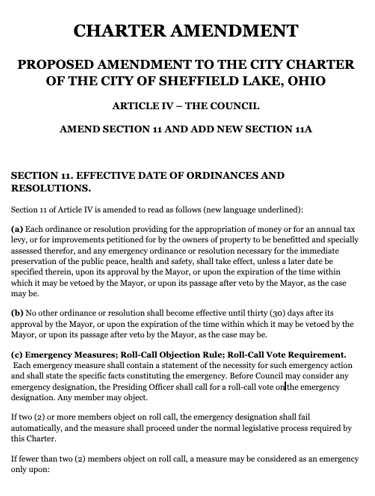
The City of Sheffield Lake passes a ridiculous amount of legislation by emergency action. This does not allow citizens time to digest and comprehend what is happening within the city. While there are indeed emergencies, we need to ensure that not everything under the sun is one.
PROPOSED RESOLUTIONS AND POLICIES
12/7/20252 min read
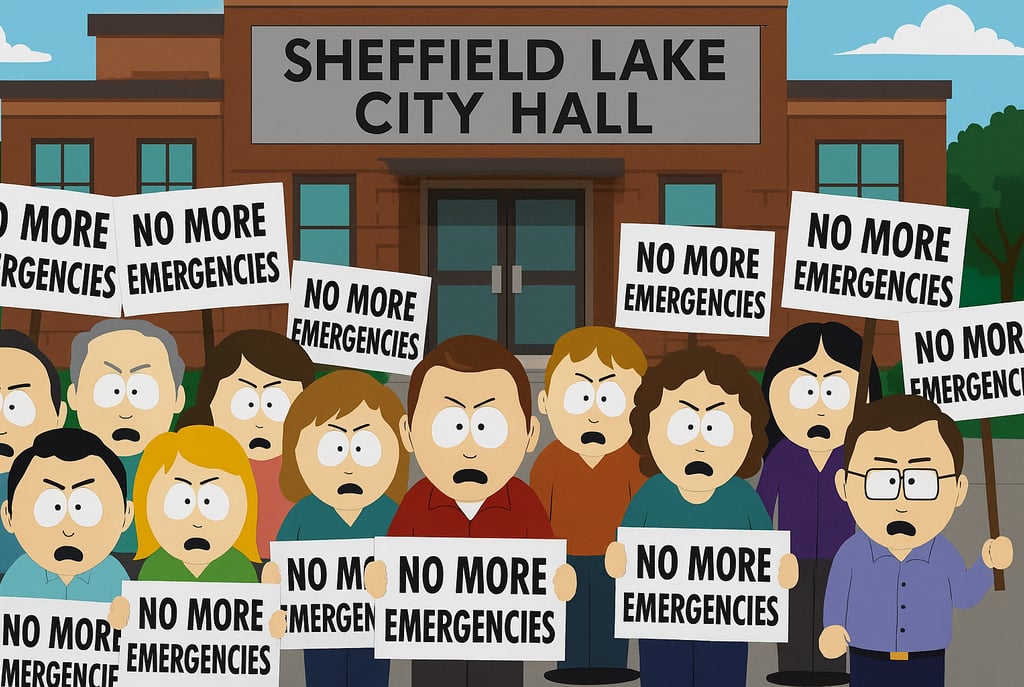
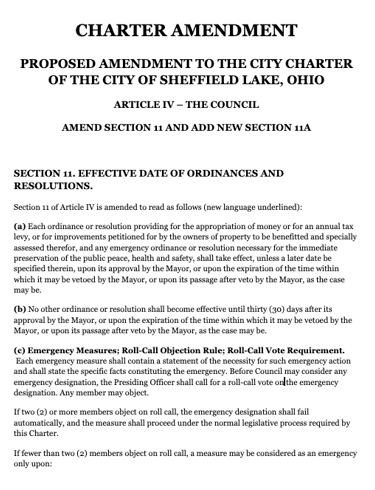
For too long, “emergency” legislation in Sheffield Lake has drifted from being a rare tool for true crises into a routine shortcut. The Charter clearly intends emergency measures to be limited to situations requiring immediate action for public peace, health, or safety, with heightened voting safeguards. Sheffield Lake City Charter Yet in practice, the label has been used so frequently that it has weakened public confidence and narrowed the space for citizen involvement.
When the Council passes something as an emergency, the normal pace of democracy gets skipped. Residents don’t get the time they deserve to read, reflect, ask questions, and respond. Instead of a public process, we get a fast track. That might be convenient for the government, but it’s not fair to the people who live under the rules being made.
The fix isn’t radical. It’s practical, proven, and familiar: adopt a process similar to the one the Ohio General Assembly uses. At the statehouse, bills move through committees, hearings, and multiple readings specifically so the public can participate and lawmakers can hear more than one side before voting. That kind of structure slows legislation down on purpose — not to block good ideas, but to make sure ideas are tested in daylight.
A Sheffield Lake advisory committee process would do the same thing locally. It would give residents real opportunities to speak their piece through written, audio, video, or in-person testimony. It would require testimony sessions for both supporters and opponents, as well as time for interested parties to weigh in. Even more importantly, posting pro and con testimony on the City website would let the whole community see multiple perspectives, not just the one that happens to speak loudest at a single meeting.
This is how trust is rebuilt: not by demanding faith in City Hall, but by designing a system that invites the public into the process before decisions are final. Emergency powers should exist for genuine emergencies. Everything else should go through normal channels, with meaningful time for citizens to be heard.
Slower lawmaking is not a weakness. It’s democracy working as it should — with the public in the room, the facts on the table, and the final vote earned in the open.
The Sheffield Lake Forum
Paid for by the committee - For a Better Tomorrow - Elect Jon Morrow
Text or call
"We all win when we make our voices heard!"
(419) 602-4425
© 2025. All rights reserved.
Disclaimer
The website www.SheffieldLake.community is both a work of irony and a platform of ideas.
It playfully satirizes the hypersensitivities of those who zealously defend Mayor Rocky Radeff’s policies, while earnestly offering real-world proposals for improving life in Sheffield Lake.
This site serves two purposes:
To highlight, through gentle parody, the contradictions and overreactions that too often dominate local discourse, and
To present serious, forward-looking solutions for residents to evaluate and discuss.
While its tone occasionally employs humor and irony, the underlying intent is civic — to inform, challenge, and inspire thoughtful conversation about the future of our city.
Authorized and maintained by Jon Morrow, Councilman-Elect, Ward 1, City of Sheffield Lake.